Hose Pumps
What is a hose pump?
A hose pump, also known as peristaltic pump, is a volumetric or positive displacement pump, transferring a specific volume of liquid on each cycle or rotation, providing precise control over the flow rate.
Hose pumps are ideal for transfer or dosing applications where accuracy and consistent fluid delivery is required.
Hose pumps can handle difficult, abrasive, corrosive, viscous and shear sensitive liquids with particles. They have a number of unique features what makes them the ideal choice, especially for heavy duty and demanding applications where other types of pumps fail.
The hose, made of various materials, suits the liquid being transferred. It is squeezed by a set of rollers or shoes to move the liquid. Low pressure hose pumps are effective for discharge pressure up to 4 bar. The friction on the hose with rollers is low, hence the hose needs just to be lubricated by silicone grease. The rollers can be adjusted, either by brackets or by shims depending on the pump size.
High pressure hose pumps generate friction and heat while compressing the hose, therefore constant lubrication with glycerin is needed to dissipate the heat. The shoe design allows the pump to operate within higher discharge pressures up to 15 bar, avoiding any blockage and optimizing therefore the hose lifetime.
The transferred liquid is only in contact with the inner surface of the hose, avoiding any sealing. This also allows an easy cleaning of the pump.
Hose pumps are simple to use, easy to maintain and reliable.
This pump has only few components and the only wearing part at the inside the pump is the hose They do not require any qualified people for operation, optimizing therefore your TCO (Total cost of ownership)
How do hose pumps work?
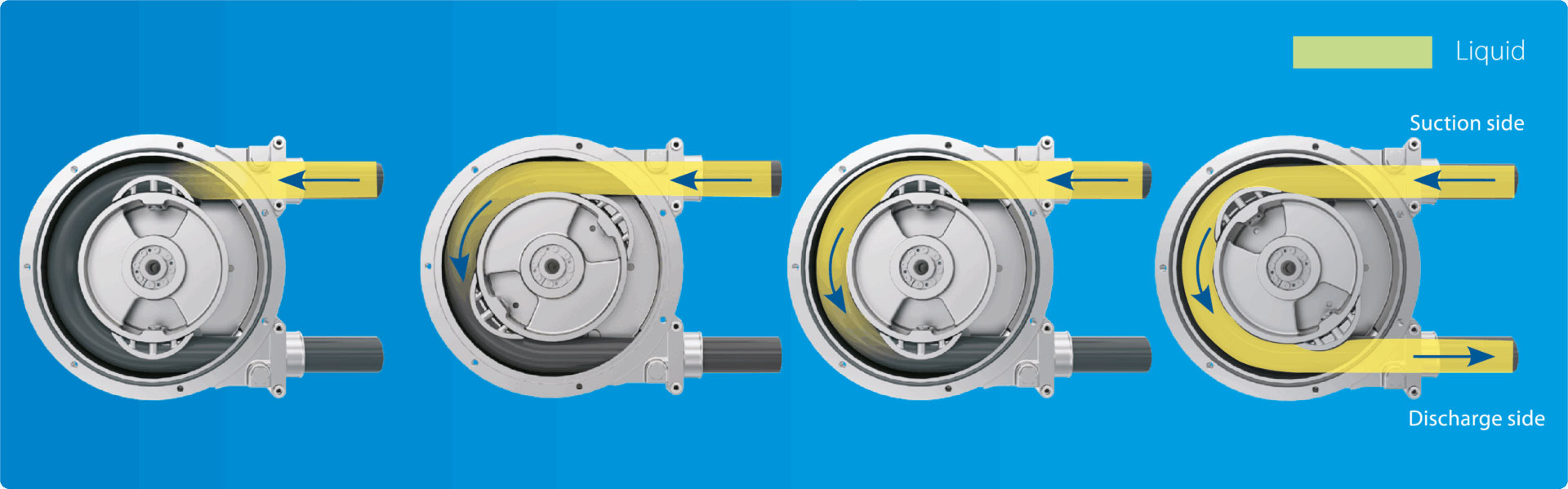
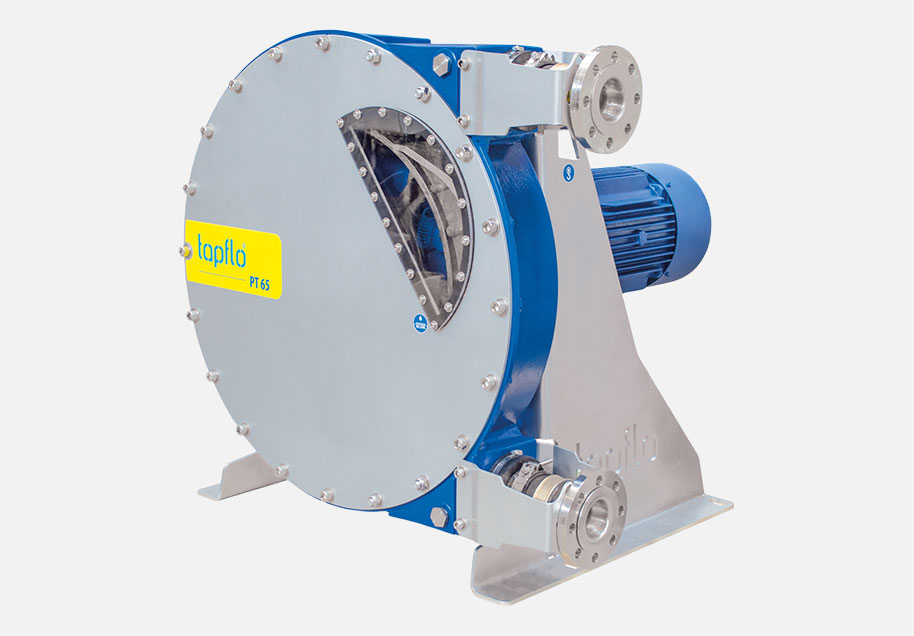
PT high pressure hose pumps have a shoe design.
The pump generates friction and heat, while compressing the hose, therefore constant lubrication with glycerin is needed to dissipate the heat. This design allows the pump to operate within higher discharge pressure up to 15 bar, avoiding any blockage and optimising therefore the lifetime of the hose.
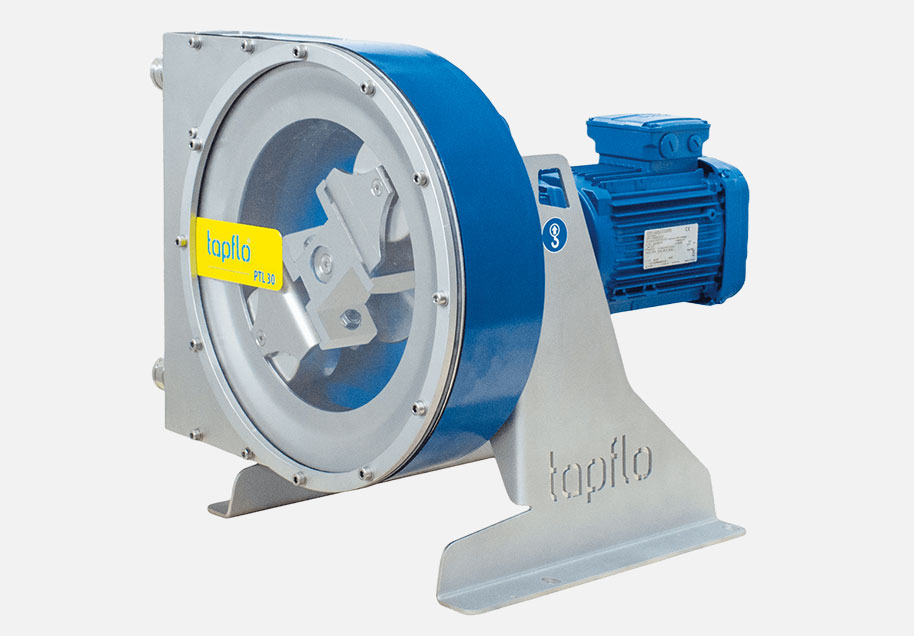
PTL low pressure hose pumps have a roller design.
This design is effective for discharge pressure up to 4 bar. The friction on the hose with rollers is lower, hence the hose needs just to be lubricated by silicone grease. The rollers can be adjusted, either by brackets or by shims depending on the pump size.
Advantages and challenges of hose pumps
PTL series
The best solutions for simple transfer or dosing applications, allowing you a quick hose exchange to optimize pump operation time.
- Tapflo Industry
- Tapflo Paint
- Tapflo Water treatment
- Tapflo Bread dough & fruit cake
- Tapflo Paper mils
PT series
Effective hose pump solutions for difficult, abrasive, corrosive & viscous liquids with particles.
- Pharmaceutical industry
- Tapflo Water treatment
- Tapflo Pasta, cheese industry
- Tapflo Bread dough & fruit cake
- Tapflo Cosmetic industry
Features & Benefits
- Pumping challenging liquids. Hose pumps are suitable for efficiently pumping highly abrasive, corrosive, and viscous liquids containing particles.
- Ease maintenance, reduced downtime. Hassle-free maintenance and minimal downtime due to few components and no seals required.
- Easy operation. User-friendly operation without the need for specialized personnel.
- Cost-effective solution. Total Cost of Ownership (TCO) for economical pumping solutions.
- Turbulence-free performance. Smooth and gentle pumping even with highly abrasive or sensitive liquids, minimizing wear and ensuring optimal operations.
- Extensive configuration options. The pump connection offers a diverse range of types and orientations.
- Self-priming Efficient self-priming with superior suction capacity up to -0.9 bar.
- Handling high viscosity. Reliable performance with the ability to pump liquids with viscosities up to 100,000cP
- Reversible operation. Versatile functionality for various applications with an easy change of rotation direction.
- Adjustable flow and precise dosing. Flexibility in flow rates and precise dosing accuracy of approximately ±5% by adjusting the speed, such as with a frequency converter.
- Safe to run dry. Safe to run dry, eliminating the need for monitoring and ensuring ease of use and peace of mind.
Challenges & solutions of hose pumps
PUMP SIZE
Hose pumps are big and require a lot of space
Solution: TAPFLO hose pumps have as a standard on:
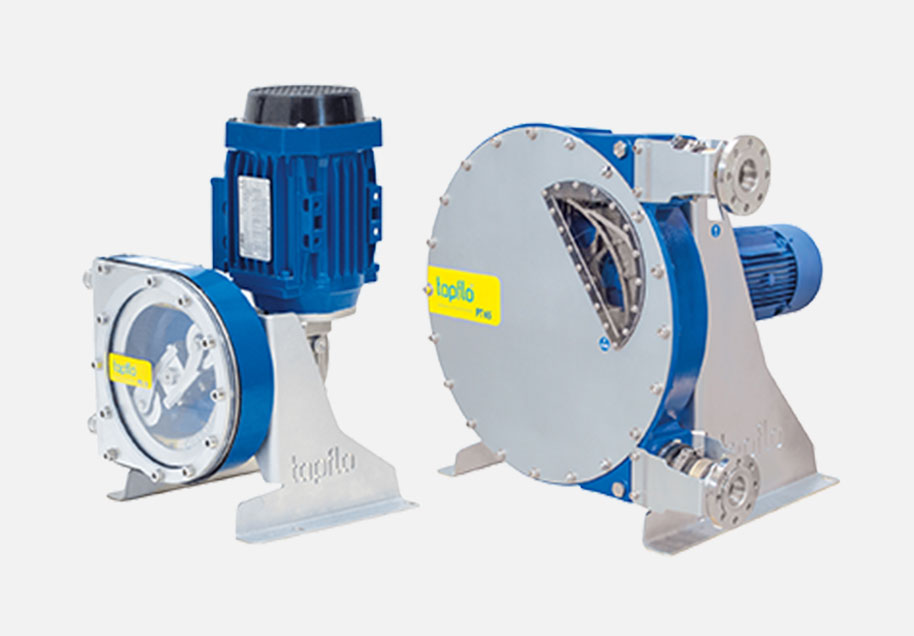
- Tapflo PTL hose pumps, have a vertical reducer, optimizing maintenance access & space.
- Tapflo PT hose pumps can offer it as an option up to PT65 size.
All bigger PT hose pump sizes (PT80-PT125) offer also a vertical reducer as a standard
PULSATIONS: HOSE PUMP GENERATE PULSATIONS
Due to their specific pump design, hose pumps generate a pulsing flow.
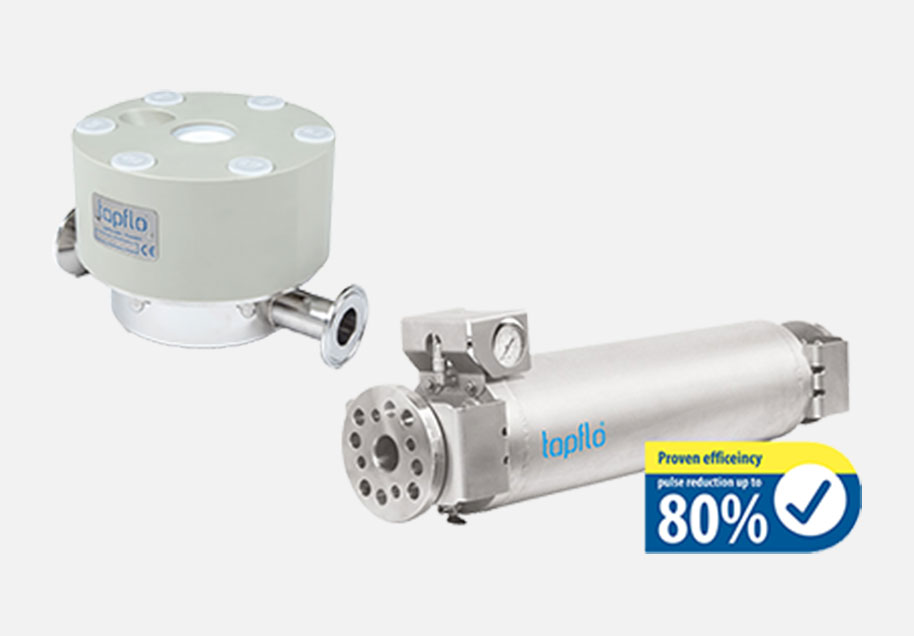
Solution: TAPFLO offers a wide range and variable sizes of pulsation dampeners.
The DT or DPT dampeners will reduce the pulsing by up to 80%.
HIGH LIQUID TEMPERATURE REDUCES THE HOSE LIFETIME
The hose lifetime is significantly reduced with a liquid temperature above 80°C.
Solution: TAPFLO offers special cooling systems to reduce the temperature within the pump casing
HOSE PUMPS ARE STANDARD PUMPS? OR SPECIAL PUMPS?
Hose pumps are standard pumps, but they can be tailored to your needs
Solution: TAPFLO Solutions offers „build in house”and „plug and play”solutions that fit the best according to your needs.
Optimizing the hose lifetime
The lifetime of the hoses depends on various factors, which are acting together:
- The working time of the pump (Continuous/Intermittent/Occasional)
(The less the pump is working the better the lifetime of the hose).
- The pump discharge pressure
(The lower the pressure, the better the lifetime of the hose).
- The fluid & particles being pumped
(Abrasive, corrosive, aggressive liquids & particles reduce lifetime).
- The pump speed
(The lower the speed the better the lifetime of the hose).
- The temperature of the liquid being pumped
(The lower the temperaturethe better the lifetime).
For high temperatures please reduce speed of the pump by 30 %
- The shimming strategy
(Less shimd = less pressure on the hose = the better hose lifetime).
Examples of the use of hose pumps
Intestinal pumps are used in a wide range of industries – from sewage treatment plants to abattoirs, food production, cosmetics, the chemical industry or the pharmaceutical industry. As a rule, we also use them where other pump technologies have mostly failed.
Wide range of applications for peristaltic pumps
- Pharmaceutical industry – pumps for this industry must meet a number of exacting requirements in terms of the materials inside the hose that will come into contact with the fluid being pumped. They perform well in chemical dosing, for the hermetic transport of products and intermediates such as liquid proteins, vaccines, serums, plasma, antibiotics or syrups, among others.
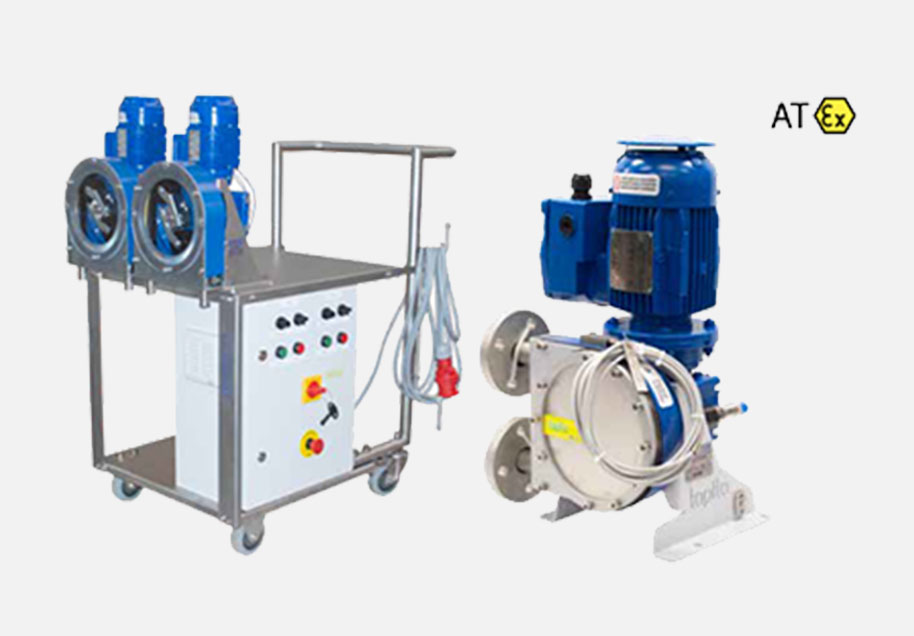
- Potentially peristaltic pumps can be installed in explosive atmospheres – both gaseous and dusty. supplies pumps and pump units fully certified according to the ATEX Directive 2014/34/EU.
- Cosmetics industry – transport of gels, creams, shampoos, emulsions, pumping of transport containers.
- Food industry – transporting or dispensing viscous products containing solid particles, such as egg whites and yolks, condensed fat, semolina, natural flavourings, cream, milk, yoghurt, fruit preparations, soups and sauces and many others.
- Wastewater treatment and water treatment – transport of media with different viscosities, e.g.: sludge, polymers, sodium hypochlorite, ferric chloride, sodium bisulphite, fluoride, polymers, aqueous ammonia solutions, potassium permanganate, caustic soda and others.
- Chemical industry – pumping paints, oil additives, detergents, resins, coatings for photographic films. Peristaltic pumps offer great potential for handling corrosive chemicals, slurries or pastes.
- Paint industry – transfer of semi-finished and finished paints.